
Execute Your Sales and Operations Plan
Do sales forecast “misses” cause Operations and Supply Chain to make last-minute changes to plans and schedules that affect the entire organization? Does your decision-making process lack alignment between key functional areas? Do these ripple effects negatively impact sales, supply chain, and financial performance?
If you struggle to turn your sales forecast into a reality because operations, supply chain, sales, and finance are not aligned, then you need to consider Sales and Operations Planning (S&OP). Sales and Operations Planning is an integrated planning process that includes demand planning, supply planning, and financial planning to help make informed decisions.
In short, it involves business planning across functional areas to improve profitability, on-time delivery, and other metrics by breaking down silos and coordinating business processes. The sales and operations planning process has often been associated with manufacturing; however, this considerably limits its use and usefulness.
Any company with resource constraints can use the S&OP process to improve profitability. Some of the most effective users are service firms with very specialized human resources and distributors managing inventory. Modern management software can significantly streamline these planning activities and support S&OP implementation across the organization.
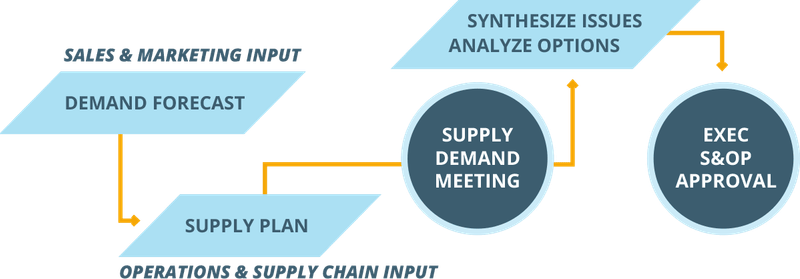
To help you get started developing and implementing your S&OP process, Supply Velocity’s consultants will conduct an Assessment. We will evaluate your business for symptoms of ineffective planning processes.
During the Assessment, we often discover necessary pre-S&OP work – for example, inventory management, supply chain planning, production planning, or material requirements planning. The deliverable of an S&OP Process Assessment is a detailed implementation plan and pre-S&OP work required to ensure success.
Implementing Sales and Operations Planning:
- Start with a pilot using only one product family and a core team of stakeholders
- Define your product families based on: product characteristics, production process, market segment, distribution channel
- Limit to 9 product families for the entire company, if possible
- Determine units-of-measure (UOM): each, case, pounds, gallons, pallets, truckloads
- Determine how to measure your capacity (for the operations plan): labor hours, machine hours, production space, warehouse pallet positions, dock doors
- Decide on your time fences and establish your planning horizon – how far in the future you will plan (forecast) internal operations and your supply chain: production lead-time, average supplier lead-time, longest critical supplier lead-time
- Create your S&OP meeting spreadsheet, tracking forecast, actuals, and available to promise
- Consider resource planning requirements and how S&OP software can automate data collection and reporting
Sales and Operations Planning Process – Timing
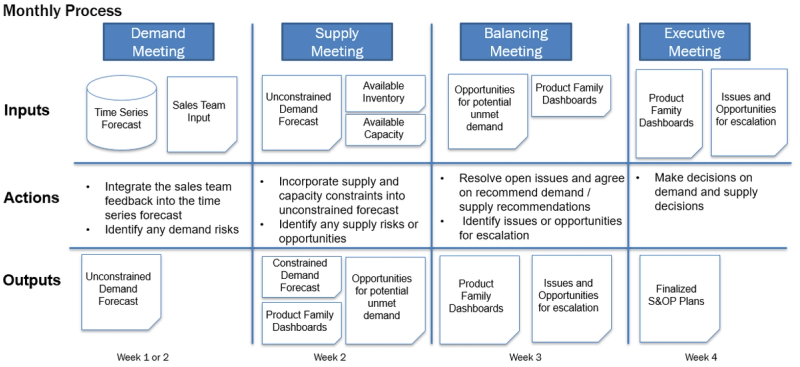
The monthly S&OP Process includes four distinct S&OP meetings as pictured above.
- Demand Planning Meeting: this meeting is typically led by the sales team using sales forecasts, marketing plans and/or sales planning to determine future demand. Automating these processes reduces the effort of data gathering and ensures consistency over time. We recommend combining a statistical forecast with sales representative input on specific customer demand information to improve forecast accuracy. The output from demand planning is an unconstrained demand forecast. New product development and timing are also important considerations when forecasting demand, requiring careful product planning coordination.
- Supply Planning Meeting: this meeting is led by the operations team and uses the unconstrained demand forecast and key KPIs such as forecast accuracy and forecast bias as key inputs. Available inventory, resource and production capacity will be integrated with the unconstrained demand forecast. The output from this meeting will be constrained sales forecasts, aggregate product family dashboards, and opportunities to fulfill potential unmet demand. These opportunities will be reviewed and discussed in the following two meetings.
- Balancing Meeting: this meeting brings together the demand planning and supply planning teams to resolve any open issues and identify opportunities for escalation to the Executive S&OP Meeting. The teams will leave this meeting prepared to present to the executive team. The key output is the data and analysis, including any critical KPIs to support decision-making by the executive team. A primary goal is to balance supply and demand effectively across all product families.
- Executive S&OP Meeting: this is the final sales and operations planning meeting each month. The teams will present the demand and supply plans, as well as any issues or opportunities that arose during the monthly process to the executive team. The purpose of this meeting is not review, it is decision-making. At the end of this meeting, there will be a clear path forward on how the company will execute the plan in the short- and medium- term. Additional strategic plans focusing on the long-term gaps may also be decided.
S&OP “Lite”
Is sales and operations planning a ‘four-letter word’ in your company? Have you already tried S&OP, and instead of helping you make informed decisions it became S&OP meeting bureaucracy? This is because many S&OP consultants use a ‘textbook’ approach. Instead, we apply the parts of S&OP that will solve your problems, not make you sit through four meetings a month, with a possible pre-S&OP meeting as well. Our ‘lite’ approach focuses on solving your problems, such as increasing capacity or throughput; improving inventory performance; and successfully launching new products. This streamlined management process is sustainable, where many ‘textbook’ implementations fall apart when a new management process becomes the focus of leadership. Keep it lite!
Buy-in, Buy-in, Buy-in
A successful sales & operations planning process requires collaboration across all business units and functions. If your executive team does not see this process as critical to executing your sales plan, operations, and financial plan, it will die. They must participate in every meeting. If monthly is too frequent, use quarterly S&OP meetings. When a S&OP process becomes a core part of your business, you can use it to plan for new products, adjust pricing based on market conditions, and achieve cross-functional collaboration throughout the entire organization. The S&OP plan becomes the foundation for all subsequent planning activities.
S&OP and Supply Chain Management
Another important consideration of the S&OP process is the integration of supply chain management. If you are not using this type of business planning, then the center of your supply chain (your company) will be out of balance. If your company is not aligned, how can your supply chain (suppliers and your customers) be aligned? A functioning S&OP process creates the foundation for supply chain management, customer satisfaction, and business process excellence. It mitigates disruptions because not only does forecasting allow you to plan for known variability, but some disruptions are created by a lack of a cross-functional supply chain planning process. By creating an S&OP Plan, you can ensure procurement’s inventory planning, finance’s financial planning, and the overall supply chain plan accounts for the sales group’s forecasts. Effective resource planning ensures that all departments have the capacity needed to support S&OP execution.
What is IBP, S&OE and SIOP?
S&OP has created variants that can seem confusing. They differ in the focus and level of thinking.
IBP, (Integrated Business Planning) is meant to cover two issues not often part of S&OP: financial integration and link to the strategic plan. Financial integration means linking budgeting and financial forecasting to the demand forecast.
S&OE is more short-term focused, using sales input and forecasting to make informed decisions about scheduling and resource allocation within a shorter planning horizon.
SIOP puts the focus on inventory management and not resource allocation. All of these approaches benefit from robust management software that can integrate data across functions and support comprehensive planning activities across the organization.