Focus on Profitability; Revenue and Cost are just inputs
To download this case study please click here.

Profitability is Key!
As business grows, declines, or remains steady, a clear understanding of profitability by segment is paramount. Increasing revenue is great so long as your costs are not increasing disproportionately. Decreasing costs is also wonderful assuming it does not harm your brand or constrain future revenue. Revenue and costs are fundamental for driving profitability, but the focus must be on their combination rather than either as a sole input.
Profitability varies by product, channel, customer, plant, etc. Understanding how these variables impact your profitability enables you to make better decisions. However, truly understanding what drives your profitability up or down is hard. Often businesses do not have the information readily available. Revenue is typically understood at the customer and product level, while costs are not, and it is often hard to allocate costs to this level. A profitability study can provide this level of visibility and help you better understand the business variables that most impact profitability.
Case Study Organization
Recently, I helped a professional service organization do a study to understand profitability across their products and customers. The organization was experiencing revenue growth but also a significant decline in net profit. There was a gut feel across most of the organization that some of their largest customers were not profitable. Internal misalignment created roadblocks for making changes without a clear view of profitability at a granular level.
Profitability Study
A profitability study enables businesses to pull together revenue and costs at a granular level to enable a clear understanding of profitability across any segment or sub-segment of the business.
Often the data to build a comprehensive profitability study is not readily available. Costs are sometimes unclear and hard to allocate to the product and customer level. In manufacturing it can be relatively easy to allocate raw materials to a finished goods, but the conversion cost including machining time and labor costs are harder to allocate.
For example, our client did not have a clear understanding of the time required by the staff to serve different customers or “produce” different products. As a professional service business, the largest cost they have is the cost of their employees’ time. To calculate labor costs, we had to understand how employee-time should be allocated to the customer and product level.
Time studies are valuable in determining how to allocate resource costs. Time studies allow you to move from gut feel to using actual data to understand how resources are being used and ultimately should be allocated.
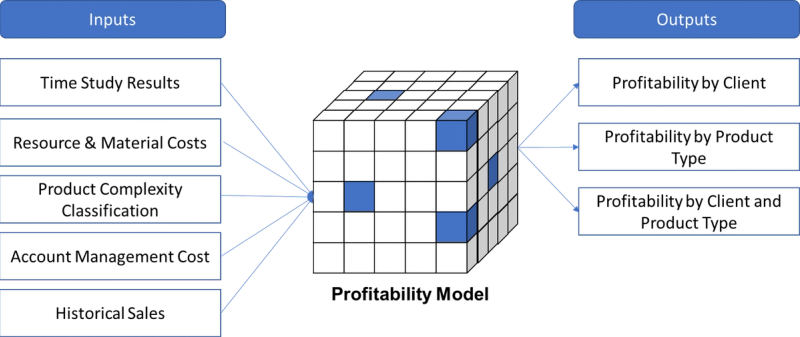
We were able to break down costs and allocate them to the customer and product levels using the following methods:
- Product Complexity Classification
- Customer customization of products significantly impacted the time required to “produce” different products. Complexity classification allowed for product groupings with similar time standards.
- Employee Time Studies
- Used to determine the standard time required to produce a specific product.
- Documentation of Account Management Time
- Our client’s customers had drastically different account management time requirements. Often account management time is left out of profitability studies, but the resource drain from some of the customers was so great, we decided to incorporate this cost.
Figure 1: Profitability Model Inputs and Outputs
Classify Complexity
The organization had four key products (or product families). During initial discussions, it was clear that each product family had different complexity levels (or levels of customization) depending on the customers’ needs. We needed to create standard costs based on a standard amount of time required to deliver the product. Standard costs could not be done at the customer level. We determined there were three different levels of complexity (standard, custom, and custom plus) across all product groupings.
Next, we had to classify each customer product type to the correct complexity level. The complexity level combined with time study results and standard resource costs, allowed us to calculate standard costs for each product family / complexity combination. With four product types and three complexity levels we needed twelve standard costs.
Many organizations have a significantly larger portfolio of products, but the same methodology can be utilized. In many businesses, the standards are more clearly defined because SKU XYZ is the same as any SKU XYZ, where in professional services (and especially for our client) each product is a little different.
Time Studies
Over several weeks all team members tracked their time by product and complexity. This was a time consuming and slightly painful process, but once aggregated we could create standard time by resource type for each product.
We did this using excel spreadsheets completed daily by each employee. The information collected included:
- Product Type
- Complexity
- Employee function
- Activity
- Time
Account Management Time
Often in profitability models all Sales and General Accounting (SG&A) activities are excluded. The focus is typically purely on gross margin.
With this client, we saw an extremely large variation in the amount of SG&A time required by each customer. Some customers just needed initial set up, then all the business flowed without significant hands-on client management. Other clients required routine travel visits, monthly or quarterly comprehensive customized reporting, and additional value-add services that were not being monetized.
An output from the profitability study would be recommendations to monetize these additional value-added services. Due to the internal struggles to understand the situation and drive change, we decided it was important to incorporate these customer specific additional value-added account management services into the profitability model.
To gather and quantify this information, we spoke to each account manager and documented each customers’ specific needs. We then quantified the travel and resource cost required to support these needs. These account management costs were then allocated to historical sales based on the quantity of products purchased by each customer.
Profitability Model
Once we gathered all the relevant data, we consolidated it into a profitability model which provided the capability to view profitability at any level of the organization. To build the profitability model we took historical sales combined with the newly created standard cost from the time studies and the allocated customer specific account management cost. This resulted in calculated profitability at a granular level. This enabled the business to look back and understand profitability for each sale they had made in the previous twelve months
By building the profitability model at the line level, we created the ability to aggregate or pivot the data to view profitability from any viewpoint. We could look at profitability by Customer, by Product Type, by Complexity Level, by Sales Rep, by Region or any combination of these variables.
Results – Call to Action
The ultimate reason for performing a profitability study is to determine what actions a business can take to improve profitability. The profitability study and model create visibility into opportunities, but that visibility has no value for the organization until they can take action based on the learnings.
Key Learning & Recommended Actions
- Select customers are highly unprofitable driven by low pricing combined with highly customized products and unmonetized value added services
- Charge for value added services
- Raise price and / or
- Move customers towards more standardized product
- Profitability varies significantly by product type – premium level product types have significantly higher profit margins and cause lower strain on the business
- Limit sales of lower level product – possibly eliminate lowest-price product offering, automate offering or significantly raise price
- Expand offering of premium products
- Ensure pricing structure does not allow for degradation of premium product sales and migration of customers to lower level products (clearly differentiate value versus price)
- Low volume customers, even when priced at a slight premium, typically have lower profitability
- Consider raising prices to the point of acceptable profitability or ending business with smaller customers and / or
- Only provide premium product types to smaller customers
A theme I see when working with clients is that having improved visibility into your business through collaboration or improved understanding of your data, consistently delivers by uncovering opportunity. That opportunity might come in a form you are expecting, and the visibility created just clarifies confirming gut feel. Or the opportunity might be in totally unexpected.
Ultimately, understanding and having more visibility into your business and the factors that drive profitability is important. But the opportunities will only materialize into improved profit for the business when actions are taken to capture the opportunity.
If you would like to speak to me more about profitability, please e-mail me at stacy@supplyvelocity.com