We help mid-market and enterprise operations teams redesign their supply chains for lower costs, faster delivery, and greater resilience. Since 1998, our senior consultants have completed 900+ projects across manufacturing, distribution, and retail, delivering measurable ROI through data-driven supply chain network design.
Your supply chain network determines how products move from source to customer. When that network no longer matches your business reality, the costs add up fast.
Aging facility locations, shifting customer demand, and growth through acquisition all create supply chains that leak margin at every turn. We help you find and fix those leaks through disciplined supply chain design and analysis.
Why Supply Chain Network Design Matters
Most supply chains evolved over decades of incremental decisions. A warehouse added here, a supplier onboarded there, a distribution center opened to serve a single retailer. Over time, these choices compound into a network that nobody designed on purpose.
The result is predictable: excess inventory levels at some locations and stockouts at others. Freight lanes that cross each other. Delivery lead times that frustrate customers. Hidden inefficiency that erodes profitability quarter after quarter.
Supply chain network design brings structure to this complexity. It replaces guesswork with data, modeling different scenarios to identify the configuration that balances cost and service while building resilience into the network strategy.
For supply chains facing demand fluctuations, geographic expansion, or competitive pressure, a disciplined supply chain optimization approach is the starting point for real improvement. It will reduce costs, shorten lead times, and align your distribution network with your business strategy and current market realities.
How We Approach Supply Chain Network Design
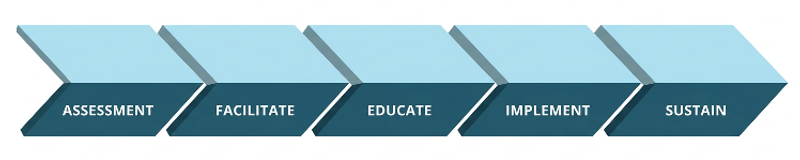
Our consultants follow a proven methodology: Assess, Facilitate, Educate, Implement, Sustain.
Assess. We start by mapping your current network from source through all supply chain networks to the end customer. This includes every warehouse, distribution center, supplier relationship, and transportation route in the existing network. We gather data on volumes, costs, lead times, and service performance to benchmark your supply chain against industry standards.
Facilitate. Using advanced modeling, we simulate your supply chains under multiple conditions. We test facility consolidation, changes in sourcing strategies, shifts in demand, and new distribution center locations. Each scenario generates a cost and service tradeoff analysis that our team reviews with your leadership.
Educate. We train your team on the analytical methods and tools behind our recommendations. Understanding the "why" behind each network change builds internal ownership and equips your people to make confident supply chain decisions going forward.
Implement. Once the optimal network model is selected, we work alongside your team to execute the transition. This may include facility location optimization, inventory repositioning, new replenishment strategies, and updated routing.
Sustain. We build your team's capability to monitor and adjust the network over time. Real-time visibility into network performance lets you prioritize improvements and respond to changes before they become a bottleneck.
Key Benefits of Network Optimization
Companies that invest in supply chain network design and optimization typically see measurable improvements across several dimensions:
- Lower logistics costs. Reducing redundant transportation, consolidating warehouse operations, and right-sizing inventory across the logistics network delivers cost efficiency gains of 10% to 30% on total supply chain spend.
- Faster delivery. Positioning inventory and distribution centers closer to where customers need products reduces lead times and helps you meet customer demand consistently.
- Improved service levels. Our clients improve service levels by redesigning how supply chains serve different channels, including e-commerce, wholesale, and direct.
- Reduced inventory. Better demand forecasting and inventory management eliminate the safety stock buffers that tie up working capital. We eliminated $450,000 in obsolete inventory in a single engagement.
- Greater resilience. A well-designed network absorbs shocks. When a supplier goes offline or a facility faces capacity constraints, your supply chains flex rather than break.
- Sustainability gains. Optimized supply chains reduce unnecessary freight miles, supporting your sustainability goals while remaining cost-effective.
What Our Network Design Consultants Deliver
Every engagement starts with data. Our consultants bring deep experience in supply chain optimization and logistics modeling, not generic templates.
Typical deliverables include:
- End-to-end supply chain network assessment with cost and service benchmarks and network cost analysis
- Network model with multiple scenarios for input costs such as fuel prices and warehouse lease expense, facility location, supplier sourcing changes due to tariffs, and distribution node placement
- Transportation strategy with optimized transportation routes, carrier analysis, and supply chain planning alignment
- Inventory optimization recommendations by location and SKU category
- A demand planning framework with inventory positioning strategies that respond to shifting volume patterns
- Implementation roadmap with timelines, milestones, and accountability for every network change
We work with your existing systems and data. Our value comes from the analytical rigor and hands-on experience our senior partners bring to each project. We do not sell network design software or push proprietary platforms. We build your team's capability to sustain improvements independently, whether that means ongoing network planning or adapting your global network to new business conditions.
Industries We Serve
We have designed and redesigned supply chain networks for manufacturers, distributors, food and beverage producers, and retailers across the United States. Supply chains in a food production facility look different from those in an e-commerce fulfillment center.
A manufacturer managing raw material flows from dozens of suppliers faces different constraints than a distributor focused on last-mile speed. We tailor every recommendation to your industry's specific operational realities.
Our network design work has helped clients in industries ranging from aerospace and defense to consumer packaged goods. In each case, the starting point is the same: understand the flow of goods through your supply chains today, then model the network changes that will lower costs and improve service tomorrow.
Whether you operate a single-facility operation or a multi-site logistics network spanning the country, our consultants help you streamline operations and improve customer satisfaction across your supply chains.
Why Companies Choose Supply Velocity
We are a boutique, senior-partner-led consulting firm. Every project is led by a partner with decades of operational experience, not delegated to junior analysts.
Our clients average five projects with us because the results speak for themselves: up to 40% increase in gross profit margins, $1.47M in transportation savings, and supply chains that deliver a competitive advantage.
With 190+ clients served since 1998 and 900+ projects completed, our track record is built on repeatable and measurable outcomes. We do not model supply chains on a screen and walk away. We work on-site with your team to implement changes, optimize processes, and build internal capability so improvements sustain long after we leave.
Our consultants work on-site alongside your team, not from a remote office. That hands-on approach is why clients come back. We transfer knowledge so your organization can sustain improvements and adapt supply chains to changing conditions without permanent outside dependency.
Get Started
A well-designed supply chain network is the foundation for lower costs, faster delivery, and long-term resilience. Contact us to schedule your supply chain assessment and discover where your network is leaking margin.
Frequently Asked Questions
What Is Supply Chain Network Design?
Supply chain network design is the process of determining the optimal balance of facilities, suppliers, distribution centers, inventory allocation and routes to optimize supply chain performance. It uses data and modeling to balance cost, service, and risk across the entire network. Effective network design considers both current volumes, projected future requirements, and the need to reduce carbon emissions from unnecessary freight movement.
How Long Does a Network Design Project Take?
Most network design engagements run 8 to 16 weeks, depending on complexity. A single-facility retail business requires less analysis than a multi-site manufacturer with global supply chains. Our consultants tailor the scope to match your needs, delivering actionable recommendations within a timeline that fits your business cycle. This time is for the analysis and design. Depending on the complexity, the implementation will take longer.
How Do You Model Supply Chain Networks?
We use quantitative modeling, scenario simulation, and hands-on operational expertise. Our team builds supply chain network models that test multiple configurations for facility locations, supplier setups, and inventory strategies. Each model measures cost, service levels, and risk to identify the strongest end-to-end configuration.
What Results Can We Expect from Network Optimization?
Results vary by industry and starting point, but our clients typically see 10% to 30% reductions in total supply chain costs, improved on-time performance, and freed working capital through better inventory management. We guarantee ROI on supply chain engagements because our approach is grounded in data, not assumptions.
When Should We Redesign Our Supply Chain Network?
Consider a network redesign when your supply chains face rising freight costs, excess inventory, declining service levels, or a major business change like an acquisition or geographic expansion. Post-merger integration, new product lines, and shifting customer demographics are all common triggers. A network redesign can surface significant savings, align supply and demand across your operations, and position your supply chains for long-term efficiency and responsiveness.