Supply Chain Strategy and Business Strategy
Creating a supply chain strategy is very similar to creating a business strategy and an operations strategy.
The difference in our supply chain consulting services is we start with an “operational” mindset and finish with a supply chain framework, built on optimization functionality.
Supply chain strategy is a plan based on facts. Facts include qualitative and quantitative data. However, a strategy is not always correct.
Steve Jobs once said, “you never connect the dots going forward, you can only do that when looking backwards.” Business strategy tries to look forward but more than anything, it seeks to align the organization to a plan.
As your supply chain consultant, we follow a supply chain informed, four-step process for developing a strategy. Note the similarities and difference between how we approach supply chain strategy and how a management consulting firm approaches a generic business strategy.
- Baseline Analysis
- Strategy Map
- Key Supply Chain Decisions
- Implementation
Baseline Analysis
The baseline analysis step is the most rigorous step of the strategic planning process. In this step, we gather information to understand both internal and external factors that impact the business.
We leverage analytics to increase fact-based decision-making and improve end-to-end visibility across the enterprise.
Analysis often performed:
- Define the problem statement:
- What are the current challenges or areas for improvement? What metrics would track improvement in these areas?
- Headline & Obituary
- Headline: what would be the headline if the company was written up in the Wall Street Journal for revolutionizing the industry? What does success look like?
- Obituary: what would the byline of the article be if the company failed and had to close as a result?
- SWOT Analysis
- We perform a detailed review of strengths, weaknesses, opportunities, and threats facing the business. Our aim is to determine how can we exploit our strengths and opportunities while mitigating our weaknesses and threats through supply chain management (SCM).
- Porters 5 Forces
- Porters 5 Forces provide insight into the competitive landscape which supports both business strategy and supply chain strategy development
- We review each force and consider them in our strategy development: threat of new entrants, supplier power, customer power, threat of substitution, and degree of competition
Strategy Map
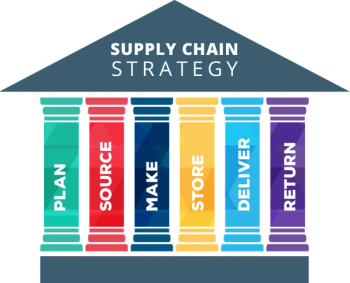
Our consulting services often use the supply chain framework, Supply Chain Operations Reference (SCOR) model. This provides a simple basis for creating supply chain process optimization and views your current operating model on an end-to-end value chain basis.
Plan
Processes that balance demand and supply to develop a course of action an operating model that best meets requirements for supply chain optimization. When planning supply chain processes, sustainability, automation and global supply chain functionality often need to be considered.
We use forecasting to understand customer demand and (if needed) plan for disruptions including shifting lead times. One well-known business tool that enables robust planning is Sales & Operations Planning (S&OP).
A well functioning Sales & Operations Planning process integrates demand forecasting, financial forecasting, cost-reduction, and supply chain and operations capacity. We include digital transformation roadmaps to support cost efficiency and better scenario planning.
Source
Sourcing processes that procure goods or services, and manage suppliers, to meet planned or actual demand (procurement / sourcing). Sourcing teams often need to support and streamline a global supply chain. In addition, stakeholders are requiring that companies have plans for sustainability in procurement operations and sourcing plans, including esg expectations.
Make
Processes that transform inputs to a finished good or service to meet planned or actual demand, and balance with procurement. Automation is a key consideration in the Make step of the supply chain framework.
Store
Processes that manage inventory for use in manufacturing or to support downstream demand. Retailers, distributors, and manufacturers in particular need to consider how their approach to Storage can help them deliver for their customers while aligning with their existing or future warehousing network.
Deliver
Processes that provide finished goods and services to customers. This includes all modes of transportation including gig-economy delivery, drones, planes, trucks, rail, barges, and ships, with a clear focus on logistics synchronization.
Return
Processes associated with returning, or receiving returned products, for any reason. In today’s ecommerce-driven economy, making it easy for your customers to return products is a critical strategic need for more than just retailers.
Our consulting firm’s Supply Chain Strategic Planning process is designed to gather facts and data, then build on the supply chain framework and pillars. We consider these six supply chain pillar categories in order to create operational excellence and a competitive advantage for our clients’ business.
A useful way to create a plan is to think hierarchically. Strategy supports the mission, so documenting the mission statement is the first step… if it does not already exist. This will be level 0 in the strategy map.
The way to achieve the mission is documented in the Level 1 Purposes, which are the pillars of the supply chain strategy. The Level 1 Pillars enable the mission.
With the pillars defined, we can create detailed supply chain operations to enable the strategy. We continue to use the Strategy Map to hierarchically create these process definitions.
Key Supply Chain Decisions
Before we move to implementation, we need to review key supply chain decisions used in your existing supply chain management and supply chain network. We want to ensure our supply chain strategy aligns to SCM best practices.
Topics our consulting firm typically review vary widely. We consider strategic concerns including new product development, economies of scale, how we collaborate and invest in a trusting relationship with our suppliers, supply chain risks, and optimization technology that enhances supply chain management.
We also integrate operational decisions into our strategy including inventory management, customer satisfaction and order fulfillment, operations planning, and the overall supply chain resilience within your organization. Our aim is to build a resilient operating model that improves service, speed, and flexibility.
One key domain of supply chain decisions is to understand how your existing strategy aligns with market demand. An effective supply chain is a competitive advantage. Do your business goals measure if your strategy is working throughout the product lifecycle?
Key Supply Chain Decisions and Tariffs
Before the COVID-19 pandemic, supply chain networks were based on best cost (price, service, quality). Most companies, even small and medium sized businesses, had global supply chains and embraced some type of low-cost outsourcing of both services and supplies. This was part of being a world-class company.
With the pandemic and Russia’s invasion of Ukraine, supply chains began to move from global to regional. Now, with the threat and reality of tariffs, companies have another decision.
How long and how large could tariffs go for your key inputs and output. It is not only where your suppliers are located, but if you should base your supply chain strategy on centralizing production in your home country.
In a world with tariffs, your purchasing may have to be regional while your production may need to become global, with a move of production to Europe and Asia.
Implementation
The organization must build processes and realign initiatives around the focal pillars. You cannot do everything at once, so we coordinate with you to prioritize two of the six pillars as having the largest gap of where you want to be.
We continue to incorporate an ideal supply chain planning strategy best suited for your organization and where you are with your current supply chain operation.
All other plans are set aside as the organization creates real-time and sustainable action items to achieve greatness for the focal supply chain pillars. We emphasize agile execution and a culture of continuous improvement to sustain outcomes and scale them.
Our first project with clients may include a demand forecasting project to support inventory-levels and other related decision-making, an analysis of suppliers for your key raw materials, or more broadly how supply chain design can help your company grow.
Supply Chain Consulting
It is important when choosing a Supply Chain Consulting Firm to understand their approach and your culture. At Supply Velocity, we have been providing Supply Chain consulting services for over 25 years, with a successful track record in operations consulting and supply chain transformation.
Our professional services help organizations across industries, from consumer goods to life sciences. We use a blend of education with a focus on implementation.
We don’t come in and develop your strategy and then hand it over. We work together to gather information and facilitate your team in developing the supply chain strategic plan. We partner with your leaders to align business goals and execution.