Download White Paper: The Bullwhip Effect in Supply Chains
One of the most important phenomena in Supply Chain Management is the Bullwhip Effect. This effect was discovered by a Stanford Business School Professor and Procter & Gamble (P&G). P&G noticed that orders it received from retailers (Wal-Mart, grocery chains, Target, etc.) for diapers varied much more than the variation in demand from consumers. It then looked upstream in the supply chain and found that the orders it placed to its suppliers varied more than the orders it received from its customers.
Dr. Hau Lee from Stanford coined the term, The Bullwhip Effect, to describe the amplification of consumer demand variation the further one goes upstream in the supply chain. A ripple effect occurs when a small movement at the handle of a bullwhip creates a large movement at the end. The bullwhip effect looks like a wave with varying high peaks and low valleys. These peaks and valleys are “artificial” in that they don’t represent the real variation between the retailer, wholesaler, distributor, and the final end-customer demand.

Figure 1: Dr. Hau Lee, discoverer of the Bullwhip Effect
In Figure 2 and 3 below you can see the Bullwhip Effect in action. Sales vary less than shipments in the top of figure 2. The furthest back echelon in the supply chain varies the greatest as shown in the bottom of figure 2. Manufacturing output decreased almost 15% in the Great Recession of 2007-2009, but total economic output decreased only 4.1%. This is due to the Bullwhip Effect.
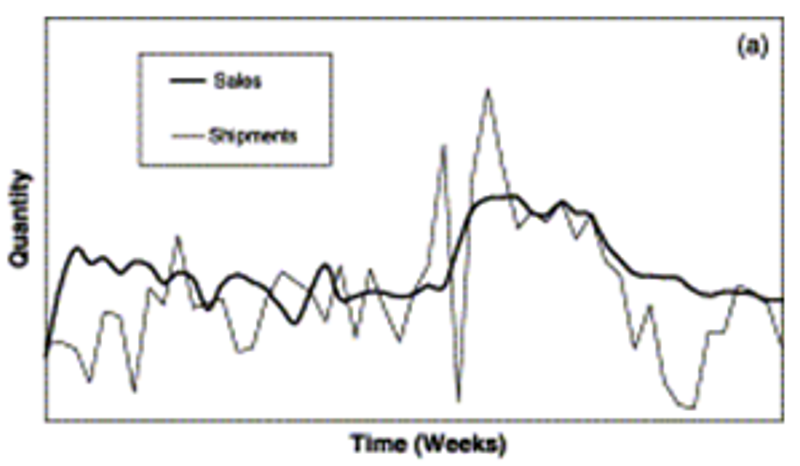
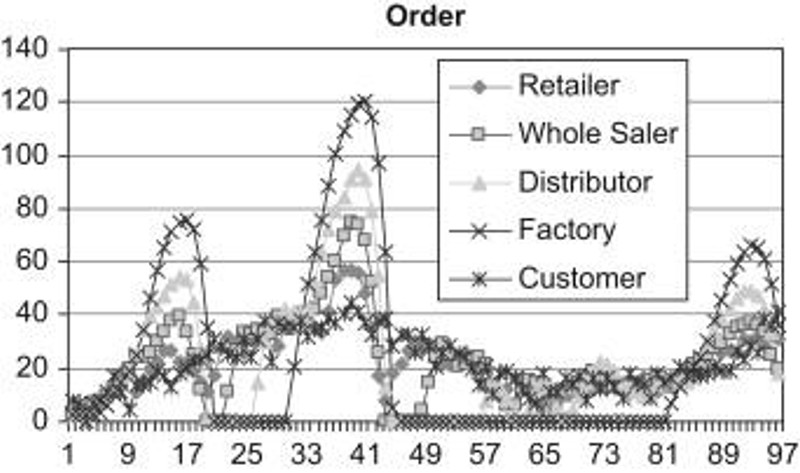
Figure 2: Examples of the Bullwhip Effect
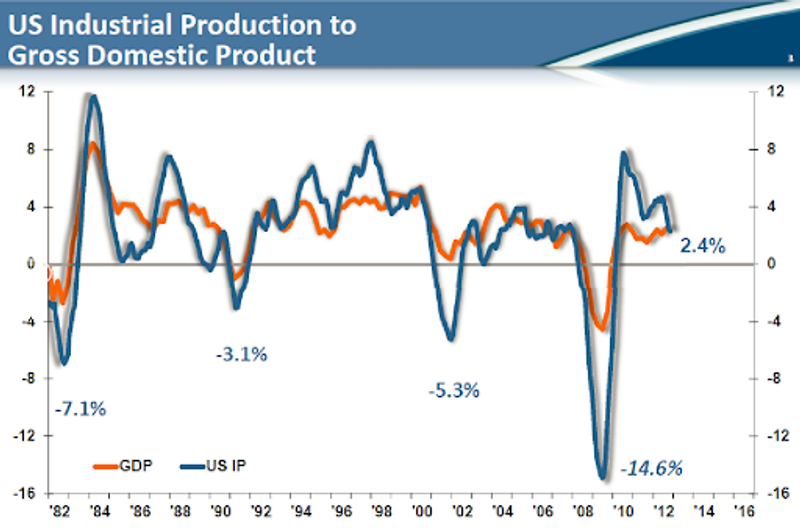
Figure 3: The Bullwhip Effect in the Manufacturing Economy
Why the Bullwhip Effect is so Bad for Supply Chains and Companies
By creating these peaks and valleys, companies have to handle demand variability – alternating periods of high demand followed by low demand. This demand variation, or demand fluctuation, occurs because companies are loath to forgo sales and want high customer satisfaction scores. Therefore, they size their factories, warehouse, staff, and inventory to handle the volatility. The entire supply chain then has greater capacity and resources than what is needed to handle true customer demand variation. In other words, because of the bullwhip effect, companies have to over-size to fulfill customer orders.
A company will have to schedule overtime, followed by periods where their employees may be idle because of demand fluctuations during a bullwhip “valley”. They will sub-optimize inventory planning and inventory management (raw materials, work-in-process, finished goods), keeping higher safety stocks than what would be needed without the Bullwhip Effect. This causes companies and the supply chain to overstock, incurring inventory carrying costs such as obsolescence, and borrowing to finance inventory. The outcome also causes warehouses to be bigger, requiring additional capital investment and greater labor. The bigger the warehouse, the more people (or robots) have to move to put-away or retrieve inventory.
The net of these outcomes is profitability erosion.
What Causes the Bullwhip Effect
Dr. Lee discovered three very common causes of the bullwhip effect. (Note, he also discovered a less common cause, which is not covered in this article.) The three common causes are:
- Over- and Under-Forecasting
- Economies of Scale in Ordering and Transportation
- Price Discounts
“Over- and Under-Forecasting” occurs when a company’s demand forecasts swings in waves that are greater than the underlying consumer or customer demand. People (being people) will react to current demand trends, even if history doesn’t support these trends being sustained. Who wants to risk product shortages and supply disruptions when demand is “going through the roof” or have high inventory levels when demand is “cratering”? However, doing this creates inefficiencies and disruptions in inventory, staffing, and overall supply chain utilization.
So what happens? People use the latest customer demand to adjust forecasts and orders to suppliers. In addition, people (again being people) forget to consider excess inventory they may already have on order, and will adjust order quantities above what a material requirements planning and execution system will recommend.
The next cause of disruption is Order Batching. Unfortunately, economies of scale in manufacturing and transportation is a real and important principle in supply chain management. Ordering, producing, and shipping larger quantities is a real-world way of reducing cost.
Manufacturing is particularly susceptible to Order Batching – When there is equipment set-up to change from one part to another, producing larger costs lets manufacturers recoup the set-up costs. This is commonly called an economic order quantity (EOQ) and is another important principle in supply chain management. Producing more for a given changeover allocates the set-up costs over larger quantities, thereby reducing per-unit costs. In addition, if set-up time is very long, a manufacturer has to be careful they don’t utilize more of the equipment’s capacity on changeovers than production runtime.
Transportation also can lead to Order Batching – While we would all like to have supplies shipped “just-in-time”, it is usually not practical or cost-effective. Filling up a large truck, rail car, barge or ship is the best way to lower unit costs of transportation. Freight rates for less-than-truckload shipments are much higher than truck-load because of economies of scale for the shipping company. It is much easier (and costs less) to fill up an entire truck at one site, drive it to the destination, and unload the entire truck. Procurement and logistics professionals often battle the economies of scale in transportation. For example, if a company needs 100 units to fulfill their production requirements for the next week, they may order 500 to fill up the truck and to receive truckload quantity costs, which reduces the transportation cost per unit. However, this 500 unit order becomes a peak of demand to the supplier when only 100 were needed.
“Shortage Gaming”
Shortage gaming occurs when there is a supply chain disruption and supply cannot keep up with demand. This was readily seen during the COVID-19 pandemic of 2020 and 2021.
When companies get put on allocation by a supplier, they will naturally try to game the system to get what they need. If a customer needs 100 units and is told they can only get 80, then probably they will order 120 or even 140 next time. This over-order stacks up until the bottleneck is relieved and the company tries to fill these over-orders. Then their customers will try to cancel orders, creating a bullwhip in demand fluctuation.
The last cause and the one most controllable is “Price Discounting”. This is one of the most frustrating causes of the Bullwhip Effect, because it seems so easily avoidable. Your internal team, including sales and marketing people who create this price volatility, and your supply chain partners know that it creates temporary and fake demand spikes. However, retailers know that they need to create retail excitement or compete during important holiday seasons. Therefore, they lower their prices, moving demand from the future (or past) to the price discounting period. Customers (or consumers) purchase more than they need, or wait until the time of the year when discounting is rampant to make their purchases. This artificially creates peaks and valleys of demand shown in Figure 2.
How to Reduce the Bullwhip Effect
There are many solutions to reduce the Bullwhip Effect
“Over- and Under-Forecasting”
One way to easily reduce “over- and under-forecasting” is to use demand planning software and computer-tolls such as AI to set demand forecasts and order materials. When computers do demand forecasts, they don’t worry about excess inventory, customer demand, or react to current forecast demands from customers. These algorithms are more logical and don’t react with over- or under-forecasting.
“Economies of Scale in Transportation”
As stated before, there is no getting around the fact that larger vehicles (ships are lowest cost, barges next lowest, rail next, full trucks next, less-than-truckload next, and parcel the highest cost) result in lower unit cost than smaller or partially full vehicles. The key is to get the large vehicle cost-per-unit, but not have to fill one up. How can you do this? … by using a third-party logistics (often called a 3PL) company. These firms work with many wholesalers, retailers, and customers to fill up trucks from multiple stops that then travel a freight lane full. It is not as inexpensive as filling up a truck all by yourself, but it is a good compromise to reduce cost and, ultimately, the bullwhip effect.
“Lean Techniques to Reduce Economic Order Quantity and Order Batching”
Another way to reduce order batching is to apply Lean to manufacturing operations. Quick-changeover or Single Minute Exchange of Dies (SMED), and 5S Visual Management, are well known methods to reduce set-up time, reducing the need to recoup long changeovers with large production quantities. The ultimate goal is to get changeovers to single minutes, or less than 10 minutes, to approach an economical order quantity to be the same as what customers normally order.
“Reduce Lead Times”
The faster a supply chain can respond to customer demand, the less safety stock is required. Safety stock protects you from stockouts due to demand variation or forecast error. It is directly proportional to lead-time. If you can reduce your leadtime from 9 weeks to 4 weeks, safety stock will go down by 33%. Even with large demand variation, this simplifies inventory planning and inventory management. Longer lead times increase the bullwhip effect because you have to forecast over a longer period of time.
Companies that want to be the hub of a successful supply chain should work with suppliers to reduce lead times.
“Break the Shortage Gaming by Fulfilling Demand based on Historical Purchases”
If a supply chain disruption occurs and limits your ability to fulfill customer orders, one way to break shortage gaming, and over-ordering by customers causing stockouts of limited inventory, is to allocate based on historical purchases by your customers. This allocates your limited supply to your best customers first and ensures you don’t sell that limited supply to your lower importance (lower demand) customers.
“Vendor Managed Inventory”
Letting vendors manage your inventory of their products gives them direct access to demand information. The over- or under-ordering and order batching causes of the Bullwhip Effect can be reduced with this visibility. With vendor managed inventory (VMI), your supplier replenishes inventory at your facility without you needing to place orders. The process can be set up as consignment inventory (the supplier owns the inventory until the customer uses it) or inventory the customer owns.
“Price Discounting vs Price Fluctuations”
Wal-Mart got it right when it introduced Every Day Low Pricing (EDLP). If people know that you won’t have a sale, they won’t wait to purchase what they need or want. If you don’t deep discount, then they won’t over-purchase causing first the sharp peak and then the deep valley of demand in the following time period. Minimizing price fluctuations helps to lessen the impact of the bullwhip effect by reducing the uncertainty and unpredictability of customer demand and variability of the flow of goods in the supply chain.
“Gather Real-Time Data on End Customer Demand”
It may seem long ago, but in the 1990s retailers computerized store registers and gained quick access to shareable point-of-sale information. This real-time information can be shared with supply chain partners. Producing and delivering to the cadence of the customer is the ultimate goal of a Lean Supply Chain. This is a Lean Pull System and reduces the supply chain volatility mentioned throughout this article.
Learn more about our Supply Chain Management Services.
“In thirty years of hiring consultants, Supply Velocity, Inc. was the first to tell me what they were going to do, set a price they stuck to and substantially exceed my expectations. I have recommended them to friends and acquaintances. They were true partners in assisting with the turnaround of an acquisition we had been struggling with for two years.Their math-based technology, solid down-to-earth facilitation skills, and positive, patient and enthusiastic attitude combined to make our implementation of Lean a very rewarding experience.
We increased our production by 50% in the first month of implementation and continue to see improvements. Improvements have not only been realized in productivity, but also in quality and morale. We have increased profitability by $2M on flat sales of $10M.
Based on Supply Velocity, Inc.’s integrity and our results, I will continue to refer them to others and utilize them in the future as we expand our company through acquisitions.”
“Your process encourages this group to work together, better communicate and have fun doing it.”
“The role of the Erie Insurance Marketing Department has been evolving over the past several years – from a support role to a more critical role of driving growth in our organization. Because of our increased workload and desire to prioritize the most critical projects, we hired Supply Velocity to teach us the skills of Lean Six Sigma.Participants included the Promotions, Market Research and Agency Licensing sections of the Marketing Department.
We learned valuable tools to help us to prioritize based on the voice of the customer.
I firmly believe these skills made a difference in how we work every day. We are moving new projects forward, eliminating or changing ineffective processes, and we are a much stronger department. We continue to use the tools to help us with our highly-complex and time-consuming projects. Supply Velocity helped us to accomplish our goals.”
“For several years we have worked with Supply Velocity to support us with their expertise on Lean Operations and Supply Chain Management. Supply Velocity has helped us implement Lean, improve our inventory systems, and educate our people. They are professionals who are always available to help us as needed.”
“We are using Supply Velocity’s Lean Six Sigma methods to analyze a variety of processes including rationalizing SKUs (stock-keeping-units). By using math to evaluate SKUs we took some of the emotion out of our decisions. We expect significant increases in sales and productivity from reducing poor performing SKUs.”
“Isolating a problem, finding short, and long term solutions with measurable results is what was promised and results is what was delivered by Supply Velocity. Upon launch of the Lean Six Sigma Selling System, we knew more about our customers, our products, and were able to create a solid plan to increase sales of our most profitable products. Within months of implementation, our booked sales jumped 60% and our most valued customers were getting direct, active, and calculable attention.”
“We engaged with Supply Velocity to help us embed process improvement at all levels of the business. Our team learned from Mitch to let the data drive decisions, to use Lean tools to help us see our processes critically and objectively, and to create a control plan to manage all of the tasks that were the outcome of the data study.The project turned out to be very significant to the company and most importantly, our customers. We reduced our customer wait times by 40%, and cut in half the labor cost to fulfill customer orders.
Some results are not able to be measured. However, as a result of this project, we have started to build a Lean mindset and culture, which is part of our strategic mission to save our customers money. Supply Velocity has been a valued partner in this mission.”
“Mitch Millstein and his team helped guide our shop fabrication division in the re-layout of our custom pipe and steel fabrication facility when we moved into a new building. It is not only the results but how he helped. We were involved in every step. I personally did time studies and was able to see the non-value added steps required to manufacture in our old layout. When we created our new layout, everyone was involved, from the executive team to our direct labor force. With Mitch’s help we increased our throughput by a 3x multiple, while providing more competitive prices to our clients as a result of the efficiency improvements.This has enabled us to not only make more money but also to expand our commercial reach and serve more, and larger customers. I would recommend Supply Velocity to any company that wants to make improvement in supply chain and operations.”
“Supply Velocity is driving instrumental change in our inventory management processes. This is critical for us to be competitive in a supply chain environment with numerous disruptions. They are making change happen, which can be challenging in a 182 year old organization.”
“I am thrilled to provide this testimonial for Supply Velocity and their outstanding work in implementing Lean Warehouses and processes at Crescent Parts & Equipment through the COVID pandemic. With their data-first focus and Mitch’s exceptional coaching and experience, they transformed our business into a more supply chain-oriented organization, enabling us to grow while prioritizing employee safety and creating a better work environment. Supply Velocity’s expertise in Lean methodologies and their comprehensive evaluation of our customers have been instrumental in optimizing our operations and increasing customer satisfaction. We highly recommend Supply Velocity to any company seeking to implement Lean processes and enhance their supply chain efficiency.”
“Supply Velocity gave us the tools to analyze our business and processes based on the facts and numbers versus our perceptions. Our common quote was “Let the numbers lead us”. The key for our organization was how quickly we moved from classroom to actual project initiation. We were able to jump in, start using the tools and see a difference right away.
The get-into-action approach was good for our culture.”
“In a time of volatile supply chain disruption, Supply Velocity is helping us develop Demand and Supply Planning processes to proactively tackle these new challenges. They are genuine partners, working with our team, facilitating and teaching.”
“Supply Velocity’s Lean Six Sigma System has given us new tools to help improve our sales performance. We have learned new ways to analyze our business which makes problem solving more accurate and has made us better leaders.”
“Supply Velocity has provided the technical expertise and political capital to move our project forward. They have just the right amount of push and the right amount of support. Supply Velocity has helped us make real changes to improve efficiencies in logistics without jeopardizing our performance. We’re happy and our customers are happy.”
“We used Supply Velocity on our Warehouse optimization project. One of the key characteristics of Supply Velocity is that they listened to our requirements and provided a clear path for our Warehouse processes using lean tools and our future sales growth as objectives.”
“C&R was struggling with labor productivity. The construction crews were often missing materials that they needed to do their work. This caused significant idle time. Supply Velocity, Inc. and C&R used value stream mapping and visual management tools to make dramatic improvements in operations. Most importantly, two years later C&R is sustaining and improving on the implementation. C&R’s return on investment was 11:1. C&R had a record year last year in both sales and profits and would not have been able to pull it off without the changes Supply Velocity, Inc. helped us make.”
“Many thanks to all three Supply Velocity presenters. I think you guys took a very difficult time for learning and capitalized on everyone’s time and training needs. I truly hope this helps your business as this was a considerable undertaking on the part of Supply Velocity. Outstanding!!”
“Our experience with Supply Velocity was one of the best values we have ever had from a consulting project. Cyril Narishkin brought a structured lean methodology, invaluable experience and engaging facilitation skills to help us streamline a very complex and disjointed sales order process. Just as importantly, our team now has the knowledge and process competencies to address other business improvement opportunities going forward.”
“We are pleased that Essex selected Supply Velocity, Inc. as our Lean Implementation Partner. At one facility, we have saved over $350,000 in work-in-process inventory, reduced throughput time from 2 weeks to minutes and increased inventory turns 3 to 8 times per year. All these results are in just 6 months. Our return of investment is very high.”
“In 2015 we began working with Dr. Mitch Millstein to optimize our inventory locations supporting e-commerce and in-store inventory needs. From this work we developed a new omni-channel warehousing and inventory plan that entirely redefined our approach to warehousing, inventory management, store distribution and fulfillment. As a result of the analyses by Dr. Millstein we have begun the move to an improved omni-channel design by reassigning MSAs to new warehouses, greater leveraging of in-store inventories to satisfy e-commerce demands, and exploring acquisitions of new warehousing space in strategic locations. We have already seen an improvement of $300,000 from both more efficient shipping strategies due to better inventory management.”
“Myerson engaged Supply Velocity, specifically Ray Davis to visit our plant in Trinidad to conduct a two day assessment of our production procedures and provide us feedback on areas for improvement and where applicable, areas for future analysis.Put simply, we got everything we paid for and in addition to more in depth analysis, we got specific tasks that were immediately actionable. Our local management team found Ray to be engaging, highly credible and insightful based on his wide experience. In other words the cultural differences and lack of specific industry knowledge weren’t impediments to things we could implement immediately and on our own. In a nutshell it was money well spent and will pay itself back many times over.”
“In the spring of 2003, the St. Louis Area Chapter of the American Red Cross engaged Supply Velocity, Inc. to perform a study and make recommendations to streamline office processes, maximize cash flow in purchasing and warehousing and restructure and enhance our maintenance department. Supply Velocity, Inc.’s process was methodical, flexible, staff-oriented, inclusive and, above all, trackable.In the last six months, our Chapter has realized expense savings of over $380,000 annually, and significant improvement in intra-company service levels has been attained. Supply Velocity, Inc. will return to the Chapter periodically throughout the next 18 months to audit our newly implemented processes. We have been pleased with our results and Supply Velocity, Inc.’s professionalism.”
“Closure Medical recently completed a major reorganization in order to enhance our ability to rapidly create innovative medical devices. We hired Supply Velocity to help us map out the process and service flows of the new organization that would maximize our product development process (PDP). In four weeks, Supply Velocity helped us envision a new PDP structure, develop measures and accountability for each step, and gain consensus within the organization. Supply Velocity’s focus on speed and accountability helped us complete a critical project in a timely fashion.”
“Supply Velocity created visibility within our Assurance Services Group… visibility of performance, Client-service, employee satisfaction and processing time. Using the Supply Velocity System, Audit Report Cycle time is down over 50%. We are using his strategies to create greater Client loyalty.”
“Supply Velocity has helped Clean succeed in a number of ways. First, they provided the education that kicked off our Lean Process Improvement journey. They also facilitated a number of large supply chain and process improvement projects including: 1) building quality into our direct-labor productivity incentive program, 2) designing the layout of our garment warehouse, and 3) streamlining our route service process.We have integrated the methods that Supply Velocity taught us into our management and strategic planning. In the process our quality measurement has improved 22% from 2013 to 2015, we have reduced required annual labor by 2200 hours from the garment facility layout project and we’ve seen 50% decrease in error rate. Obviously the numbers speak for themselves, but just as important, Supply Velocity has been fun to work and have become true partners. They have “taught us how to fish” so our internal teams are able to implement change on their own, with the skills we learned from Supply Velocity. This relationship has been invaluable.”
“Anheuser-Busch Precision Printing had been implementing Lean Operations on our own for the past two years. We needed to move faster and partnered with Supply Velocity, Inc. Through Supply Velocity, Inc.’s mathematical workflow balancing and visual management tools, dramatic improvements were achieved. The entire converting operation was rearranged based on Lean principles. The result is a 20.6% productivity improvement, enabling us to operate with 23 fewer people in production.”
“We used Supply Velocity to rethink our sales process. By analyzing the entire process we found wasted time in our Sales, Admin and Operations departments. Streamlining this process created extra time for each Sales Rep, allowing them to spend more time with Customers and increase the value we add. Gross profit margins are up 40%!We are now using Supply Velocity to help us rethink our entire Strategic Plan.”
