Download White Paper: SKU Reduction The Biggest SKLUsers
Background
A Value Stream Assessment (See White Paper: Finding Productivity Improvements from Field to Table) at this Grocery Retailer & Distributor determined that core-items (stock keeping units or SKUs) for sales and distribution to licensees have increased from 2200 to 2800 SKUs, over the last four years during a period where revenue was flat.
It is common for companies to add SKUs in hopes of “stoking” sales. Our experience demonstrates that adding SKUs, without eliminating poor performing SKUs, only reduces profit.
This white paper will study how this company used multiple sales variables (sales $, unit sales and margin $) to determine which items they needed to reduce. This project was called a “triage” project by the CEO of the company because our job was to quickly determine which SKUs to cut and which to keep. The scope was not to create a filter that could be used to screen new items. The project was meant to provide quick answers on how to get back to the historic SKU count.
Our analysis showed that targeted SKU reduction would have a quick impact on labor productivity and increased same-store sales. For details of how SKU reduction turned into improved labor productivity, see White Paper “Improving Productivity through Minimum Case Order Quantity Analysis”. The reason we will increase sales will be shown below.
A Supply Velocity Consultant led a team of employees through this 5 week project. The Supply Velocity consultant facilitated, but the employees did most of the analysis and therefore owned the improvements.
Project Outline
- Conducted Sales Pareto Analysis to confirm that low performing SKUs exist
- Nicknamed SKLUsers
- Identified what variables define a high performing SKU
- Calculated an “Overall Performance Factor” for all items using Multi-Variable Pareto analysis based on:
- Sales $
- Unit Sales
- Gross Margin $
- Sorted the SKUs based on this Overall Performance Factor from best to worst
- Identified the bottom 25% as poor performing (The Biggest SKLUsers)
- Reviewed how eliminating these SKLUsers would increase Sales
- Used information from the Minimum Case Order Quantity project
- Mapped the process for discontinuing these items and dispositioning existing inventory in the stores and warehouses
- Created a process to build this calculation into annual category reviews to help make room for new items and/or increase shelf-space for high-performing SKUs
While our initial Field to Table Study showed that SKU count had grown and sales remained flat, we wanted to know the full extent of the problem. We conducted a quick Sales Pareto analysis. As the graph on the next page shows, the drop-off from the best 25% to the worst 25% was dramatic. The bottoms 25% (or 700 items) is only 1.5% of sales.
We indeed had SKLUsers (our nickname for low performing SKUs). We then used Multi-Variable Pareto analysis to identify which items were the SKLUsers based on a mix of measures. Multi-Variable Pareto was used, versus just a straight sales analysis, because of the importance of different sales variables.
Sales $ is the most common performance measure. Others argued that Gross Margin $ should be used as this represents cash flow. Still others thought that if an item is a low per unit price, but had high movement this should be considered because volume is a big driver for this business.
As we looked at the data we saw that different SKUs were strong or weak in various measures. For instance, this company loses money on some items to drive sales (loss-leaders). These items had negative margin $’s, but drove significant sales and units (and traffic into the store).
What defines a great or poorly performing SKU is multi-dimensional, which drove the use of Multi-Variable Pareto analysis.
Pareto Chart of Sales by SKU
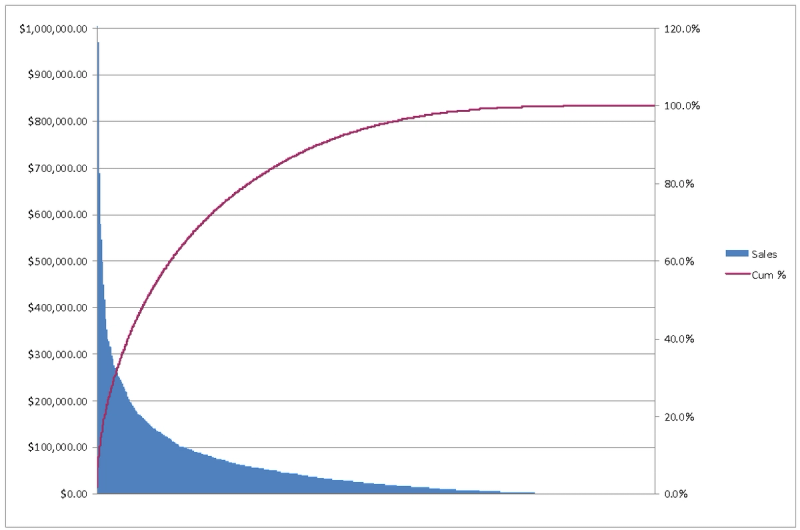
The top 25% of SKUs represent 70% of Sales
The bottom 25% of SKUs represent 1.5% of Sales
Multi-Variable Pareto Analysis
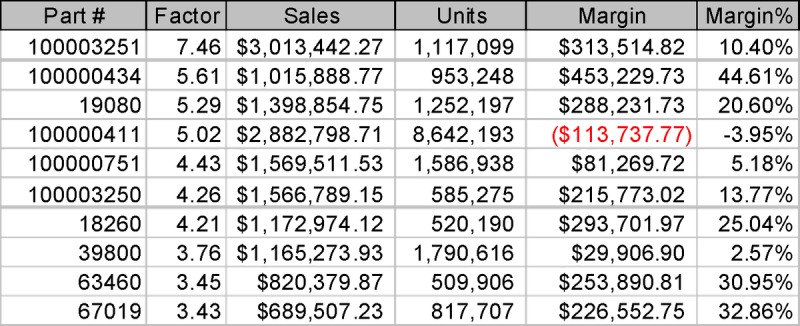
Our Multi-Variable Pareto Analysis created an Overall Performance Factor. We calculated this factor for all SKUs and sorted from highest performing to lowest. Below are the top 10 and bottom ten SKUs.
The data below is the trailing 12 months of sales.
Top Ten Items by Overall Performance Factor
Bottom Ten Items by Overall Performance Factor
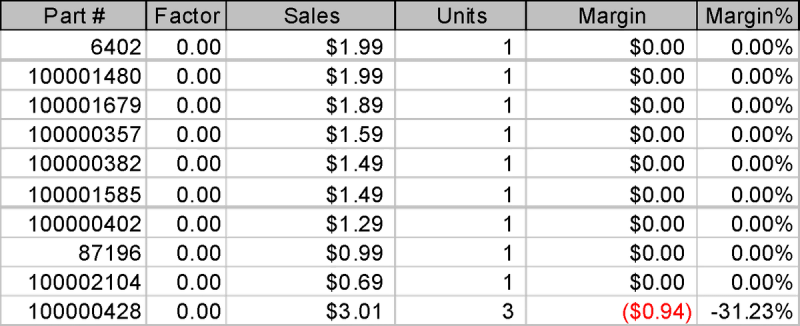
What was most shocking was not the performance of the top 10 items, but the extremely poor performance of the bottom 10. These SKLUsers sold about 1 unit each over the last 12 months. In stores and the warehouse they were just gathering dust, and eventually would have to be thrown away or deeply discounted.
Additional Analysis Results
We also sorted the SKLUsers (bottom quartile based on overall performance factor) by Category. This company uses Category Managers, who are responsible for the sales and profit of items within their category. (The categories are given code names)
The worst four categories had over 50% of items in the bottom quartile of overall performance. These categories need to be reconsidered. For example, is the item assortment wrong, or is this category being given too much space in the stores and warehouses?
The categories below had double-digit percent SKLUsers. These categories needed to be trimmed, with the worst SKUs eliminated and the best given more space on shelves.
There were categories with a very low percentage of SKLUsers, which are not shown below. These categories were given some of the space and focus previously given to the worst 4.
% SKLUsers in each Category
- Category BY: 81.6%
- Category HB: 59.1%
- Category HL: 58.6%
- Category NF: 52.3%
- Category ET: 27.2%
- Category GC: 24.2%
- Category CMS: 19.4%
- Category GSM: 19.2%
- Category PR: 18.0%
- Category LS: 14.4%
- Category SK: 12.3%
- Category ICT: 12.1%
- Category PF: 11.4%
- Category SP: 10.4%
How Eliminating SKUs Increases Sales
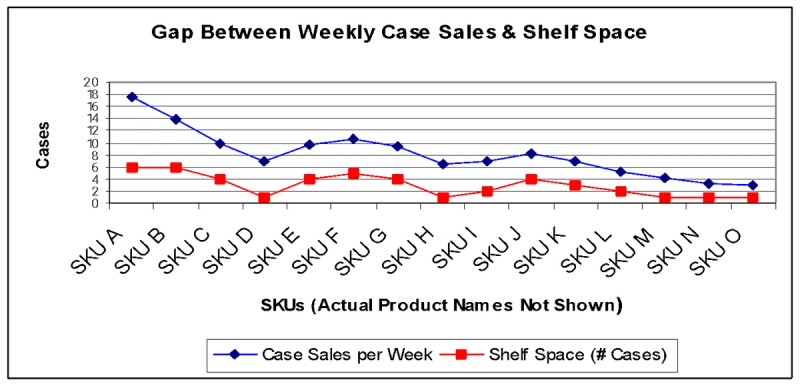
The literature on SKU reductions states that reducing SKUs in a retail setting will actually increase sales. The reason is shown in the graph below. This graph shows average weekly case sales of different items. The red (lower) line is the shelf-space (also known as pack-out) given to various items. The blue (top) line is the weekly case sales. The gap represents a mismatch between sales and space. Verification of the items with the greatest gap showed that we are losing sales of these items due to stock-outs. Customers reach for these popular items and there is nothing on the shelf.
We need to give the space that SKLUsers are taking in the stores and warehouses and allocate it to these items. These items deserve greater shelf-space. When this happens we can ensure that the most popular items don’t run out.
Communication & Control Plan
- Created a process to build this calculation into annual category reviews to help make room for new items or increase shelf-space for high-performing SKUs
- Mapped the process of discontinuing these items and dispositioning existing inventory in the stores and warehouses
We did not want this project to be a one-time effort. If it was, then in a few years SKUs would grow again. After the analysis we mapped out how to use this process as part of an ongoing “Category Review”. This ensures that we build in SKU Rationalization into the company.
In addition, we took this process all the way through the dispositioning of SKLUser inventory. SKUs that are not selling must not only be discontinued, but also need to be depleted out of the stores and warehouses.

Results
As of the date of this report, it is too soon to report on actual Sales improvements, however we are confident this project will positively impact inventory, sales and costs.
We expect sales will improve due to eliminating stock-outs of popular items. Labor costs will go down by eliminating the handling of these low volume, slow moving, items. In addition, we expect a reduction in inventory after these slow moving items are eliminated and not replaced.
Learn more about our Inventory Optimization Services.