Download White Paper: Lean System Design
Who Can Use Lean
“I thought Lean was only for Manufacturing.” If I had a dollar for every time I heard this statement… I would have, well, a few thousand dollars. Yes, Lean was created by a company whose ‘operations’ were manufacturing (Toyota). However, in the last 30 years, it has been readily adopted by organizations with ‘operations’ that are not manufacturing. Lean is used to streamline operations in financial services, the military, healthcare, construction, retail, professional services, distribution – and more. You cannot find a major bank or any hospital not using Lean.
Who can use Lean? Anyone and everyone. Any company that has a process to fulfill customer demand can use Lean. This includes real estate, hospitality, technology, lawyers, accountants, retailers/etailers, logistics, psychological testing, home services, construction, banks, insurance, hospitals, distributors, government, and yes; it still works in manufacturing.
What is Lean?
Lean is a philosophy of continuous improvement that can be captured in three succinct definitions.
- A set of tools that help identify and eliminate non-value-added work
- A deep and profound respect for the people that do the work
- Swift and even flow
Identify and Eliminate Non-Value-Added Work
Identifying and eliminating non-value-added work is the ‘nuts and bolts’ of Lean – the tools many Lean practitioners use, such as 5S, quick changeover, kanban, flow manufacturing, value stream mapping, and more. We can also add the visually oriented Six Sigma tools such as fishbone diagrams, Pareto analysis, and scatter plots. When implementing Lean in a Kaizen event or Lean Six Sigma project format, you are doing this. We use these Lean tools to fix the leaking of profits in your company and processes.

Non-Value-Added Work in Processes Creates Profit Leakage in your Business
A Deep & Profound Respect for the People who do the Work
Having a profound respect for the people who do the work is the soul of Lean and differentiates Lean from other business methods such as Six Sigma. Lean companies and Lean practitioners always involve the people who do the work when improving an area or process. Lean people think about how to support those who do the work. This can be making tools, information, and materials more convenient to retrieve or mistake-proof a complex operation, making it easy to do correctly.
It may be helpful to think of the opposite of Lean when thinking of a non-Lean approach; management or professionals in the company develop and implement an improvement without much notification or input from the people using the ‘improvement.’ It could be a consultant using lots of data and interviews with executives to develop a solution in isolation. When we get asked to ‘do’ Lean without involving the people who do the work, we tell them that it cannot be done. It is an oxymoron.

Being Lean Means Having a Deep & Profound Respect for the People Who Do the Work
Swift & Even Flow
Creating swift and even flow is the goal of Lean System Design. In many companies customers don’t order from a company consistently or predictably. Demand has peaks and valleys and is often seasonal. Given the variation of demand and supplier deliveries, a Lean company still strives to deliver its product or service fast and consistently. We developed a Lean System Design and the pillars of this strategic approach to Lean to achieve a swift and even flow.

An Everyday Example of ‘Swift & Even Flow’ is a Traffic Roundabout
Ways to ‘Do’ Lean
Toyota first developed Lean in the 1950s as a production system. Over the years, it has thrived (versus other business improvement methods) because practitioners have developed models to adopt Lean to their industry, company, people, and processes. Lean System Design is one of these new models. Some of the well-known ways to implement Lean are:
- Two-Second Lean
- Kaizen (Rapid Improvement) Events
- Lean Six Sigma Projects
Two-Second Lean
The Two-Second Lean model is an employee engagement model that uses the tools of Lean to get your entire company involved in continuous improvement. This method gives people time to make improvements every day, takes advantage of the prevalence of smartphones to take videos of these improvements, and celebrates advances every day as a team. It is the most hands-on, employee-engagement way to implement Lean. It puts the responsibility on every person in your organization to make lots and lots of minor improvements. Save a few seconds… great. There is no need for groundbreaking change; just use your brains to improve every day.
The challenge is that this is an all-or-nothing approach to Lean. The company must follow the formula daily; if not, it is nearly impossible for the Two-Second Lean approach to work. Of course, many Lean Practitioners would say that about Lean, no matter how it is done.
Kaizen Events
Kaizen events are a way of implementing Lean in a very focused one-week or shorter duration. The Lean or Kaizen team starts on the problem or focal area Monday morning and wrap up the implementation by Friday lunchtime. While the focus of a Kaizen event is the activities done in the week (but can also be done in two-, three-, and four-day durations), a few weeks of planning often precede the event to ensure all of the required data has been captured. One of the keys to a Kaizen event’s success is planning done in the weeks before the event.
Companies use Kaizen events for a few reasons. If the scope of the problem or area is small, it is a way to implement Lean quickly, eliminating unnecessary gaps when work on the area or the issue needs to be done. Many organizations use it because it gets everyone working on only the focal area or problem. Otherwise, the day-to-day activities of running the business would be the priority.
Like Lean Six Sigma, discussed below, Kaizen Events are based on understanding the current state, identifying non-value-added work, creating ways to eliminate it, and then developing the future state.
Lean Six Sigma Projects
When the scope of the improvement area or problem 1) crosses multiple departments, 2) the solutions need to be tested and validated, or 3) the data required cannot be defined upfront, the Lean Six Sigma project format can be the best way to deploy Lean. This approach is more systematic than Kaizen Events and follows the DMAIC (Define, Measure, Analyze, Improve, Control) model from Six Sigma. Lean Six Sigma is different from Six Sigma, with its more quantitative approach, but we have found the DMAIC steps to be a checklist to ensure the improvement is robust and sustainable.
- Define: Define the problem, usually via a problem statement. This step also clearly defines the scope of the process or work area included in the project.
- Measure: Measure is more than numbers. It includes gathering any data needed to solve the problem or streamline the process. This can be a process flow map, interviews with subject matter experts, time studies, spaghetti maps, or numerical data gathering.
- Analyze: Analyze in Lean Six Sigma involves looking at the data to identify non-value-added work. At Supply Velocity, we often color code process flow maps or time study steps green for value added to the customer, yellow for non-value added but necessary, or red for non-value-added and should be eliminated. It can also include doing velocity analysis using Pareto charts or prioritizing potential causes for poor performance using a fishbone diagram.
- Improve: Improve is when improvement ideas are generated to eliminate the non-value-added steps. We often prioritize these ideas into ‘do-now,’ ‘do-next’ and ‘do-later’. The ‘do-now’ ideas provide a fast return on investment. The ‘do-next’ ideas require additional thinking, development, or expenditure. The ‘do-later’ ideas need to be evaluated to ensure they provide a return and may be discarded.
- Control: Control ensures the improvement is sustainable. This may be based on 5S audits, developing standard operating procedures (SOPs), or creating performance scorecards for the work area that track key performance measures impacted by the improvement.
Lean System Design
Lean System Design creates the framework for all parts of the company to work together to deliver on your strategy. Who has visibility of all the parts? The executives: the CEO, President and COO. This is why Lean System Design is a strategic model – it belongs in the ‘hands’ of the people who can look across all functional areas.
Within the six pillars of Lean System Design are tools and techniques borrowed from Lean Process Improvement, Supply Chain Management, Planning, and Analytics. These tools give executives something ‘concrete’ to use to improve critical business processes. However, it is the interconnectedness of the pillars makes Lean System Design work. Robust planning well leads to excellent sourcing. Great sourcing leads to great operations. Great planning, sourcing, and operations lead to effective storage. Great storage leads to excellent service and product delivery, and when needed, the return process is planned and streamlined for the company and customers.
What is the result of a Lean System? A Swift and even Flow of your products and services to your customers.
The job of the CEO in a Lean System
Too often, CEOs are asked to ‘create a Lean culture.’ People who deal with culture know that Lean can only flourish in a culture when it becomes part of it. But making your culture ‘Lean’ will never work. This happens over time when you have a Lean System, with strategy deployment and an implementation plan focused on leveraging your people. The CEO is the chief executive of the Lean System.
The Six Pillars of a Lean System
- Plan: processes that balance supply and demand to develop a course of action that best meets supply and demand
- Source: processes that acquire labor, material, equipment, information, and services, and the management of those suppliers to meet customer demand
- Make: processes that transform information and materials into products and services.
- Store: processes that buffer resources and capacity and prepare for disruption to ensure the supply of products and services to customers
- Deliver: processes that provide goods, services, and information to customers.
- Return: processes associated with receiving returned products or recovering from a service failure
Plan
- Demand Forecasting
- Capacity – understand bottlenecks (Theory of Constraints)
- Sales & Operations Planning
Planning starts with a forecast. I once had a Client tell me that forecasting is the other ‘F’ word in business. Get finance, operations/supply chain, and sales/marketing people in a room and ask how the forecast works and you will get an immediate argument. Finance doesn’t understand why forecasts don’t align with budgets. Operations doesn’t understand why Sales cannot provide an accurate forecast. Sales are tired of hearing everyone complain, so they most likely stop providing a forecast or base it on the sales budget (which is not a forecast).
Forecasting demand is critical. Forecasts provide visibility into future demand for planning resources (labor, inventory, information systems, equipment). It is the first pillar of Lean System Design because without a view of potential future demand, the rest of your system based on disparate guesses. When all you are doing is guessing, you cannot Deliver your product or service to your customer quickly and efficiently.
If we begin developing a demand forecast with the understanding that there is no such thing as a consistently accurate forecast, we can make progress. Forecasting is inherently inaccurate. Few people (or no one) can predict the future. The best example of businesses seeing into the future happens in the Finance industry. However, traders making prescient trades one year often make the worst in the following years. Instead of asking for an accurate forecast, the better way to think about improving forecasting is to reduce forecast error or the difference between the forecast and the actual demand. If the forecast for an item is 125 but the actual demand is 100, the forecast error is 25%. There is a positive bias if the forecast is consistently higher than the actual demand.
The best way to forecast is to start with a statistical model using historical data for each product or service. This can be as simple as a trailing three-month average or more sophisticated exponential smoothing models that use optimization to minimize forecast error for each item. It is essential to note that the forecast is in units, not a dollar forecast. Connecting the item forecast to budgets is done later in the process. For an effective system, it is crucial to understand the forecast in units. This statistical or algorithmic forecast is then handed off to the sales team to validate and use as a tool to talk to customers about their demand plans. The sales team makes adjustments, and these are uploaded to the ERP as the final product or service (unit) forecast.
The next step in planning is to understand your capacity. This is measured where a constraint prevents you from fulfilling customer demand. Constraints are often specific skilled labor, such as programmers, specialized capital equipment, warehouse space, or constraints in the supply chain at critical suppliers. To use capacity in your planning, it must be unitized, requiring a standardization of the unit of measure. Some product families can be based on weight (grams, KG, pounds), others on liquid volume (gallons), and others on ‘eaches’ or cases.
The highest level of planning is implementing Sales and operations Planning (S&OP). Note that this planning method has other names such as Sales, Inventory & Operations Planning (SIOP), and Integrated Business Planning (IBP). For a complete understanding of S&OP, see our whitepaper (https://www.supplyvelocity.com/the-benefits-of-sales-operations-planning-sop/) and S&OP service summary (https://www.supplyvelocity.com/services/sales-and-operations-planning/).
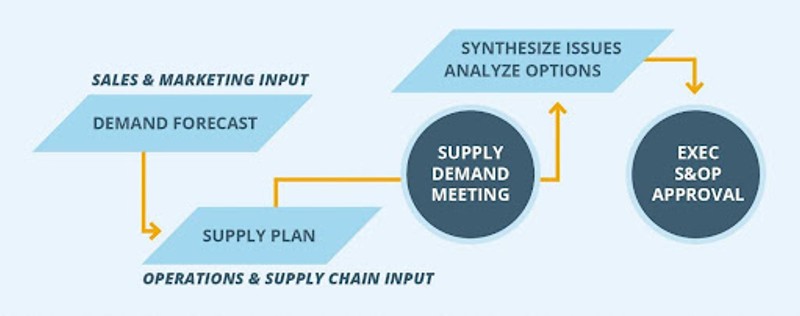
The S&OP Monthly Process
Source
Sourcing is strongly associated with purchasing physical goods, but all companies must source and procure equipment, talent (recruiting firms and staffing agencies), software, and services. Many companies in the service sector give sourcing little effort or attention. Still, supply chain management applies to managing suppliers of all kinds and can yield a competitive advantage.
The level of trust you put in your supplier is at the heart of your sourcing strategy. Below is a hierarchy of trust from highest to lowest.
Equity Investment: When a company makes an equity investment in its supplier, it expects both financial gains and a reduction in the cost of doing business. This cost is based on the theory of Transaction Cost Economics. Oliver Williamson won the Nobel Prize in Economics by realizing that every transaction has a cost, but when people are in the same firm or share ownership, that cost is reduced. Equity ownership should align two firms and lower transaction costs.
Business Process Outsourcing: When I talk about outsourcing, I mean working with a supplier who is responsible for part of your cash flow or who is the last company to touch a product or service before it goes to your customer. This requires a high level of trust and is often codified in service-level agreements that contractually set supplier and customer expectations.
Platform Participant: Many of us participate in software platforms and may not realize it. ERP, CRM, WMS, and many other types of software create communities of users. Platform participants attend regional, national, and global user conferences. They get involved in product development and provide product testing to be able to see features early and influence features that are offered. In many cases, competitors who use the same software will set aside their competitive instincts to support the software platform they all use. Becoming a part of their platform creates a high-level trust-sharing relationship with your supplier. It is difficult to switch software platforms, but even harder to lose your community.
Preferred Supplier: Many companies create preferred supplier relationships with their 80/20 suppliers, or the 20% of suppliers responsible for 80% of the total spend. Preferred suppliers will be involved in collaborative planning, forecasting, and replenishment or CPFR to ensure alignment and availability of products or services. They also get involved in joint product development, where the supplier will develop modules of a product or service that integrate with their customer’s new offering.
All four levels of trust create a requirement of trustworthiness. Many suppliers also sell to your competitors, and creating a partnership requires the supplier to maintain confidentiality of business plans, forecasts, and new product development initiatives.
Transactional Supplier: The last level of trust is a transactional supplier. These 20/80 suppliers, or 80% of suppliers, are responsible for only 20% of your total spend. The vital aspect of managing these suppliers is that it is OK to have an ‘arms-length’ relationship with them. You do not have to have partnerships with every supplier. Most of your suppliers are not that important to you, and you are not that important to them. Contracts are not necessarily needed; you don’t need to invest much in these relationships. However, if this is how you manage all your supplier relationships, you can improve your company’s performance by working with the right partners.
Make
Make is part of your business that transforms materials and information into products or services. This is where the traditional tools of Lean are used. These tools can be categorized as:
- Mistake-proofing
- Visual Workplace
- Visual mapping
Mistake-proofing reduces, prevents, or eliminates the possibility of making an error. I also like to think of it as making it difficult to do work the wrong way (or easy to do it the correct way). This can be done with tooling that only allows parts to be put into machines the correct way, a visual workplace that makes it easy to see how to do work correctly, or the use of sensors that prevent incorrect processing. Many kinds of software are a type of mistake-proofing by preventing illogical data from going through the process.

A ‘Low-Tech’ Mistake-Proofing Example
A visual workplace is based on 5S Visual Management, a five-step process for organizing and standardizing the workplace by increasing visibility. It is clutter-free and clean, makes it easy to see where things are below, has visual standards (such as housekeeping), and is sustained. Below is an example of a visual poster to keep the warehouse organized. Another example of a visual workplace is having good aisle signage (for a warehouse) so people can quickly identify where items are stored.
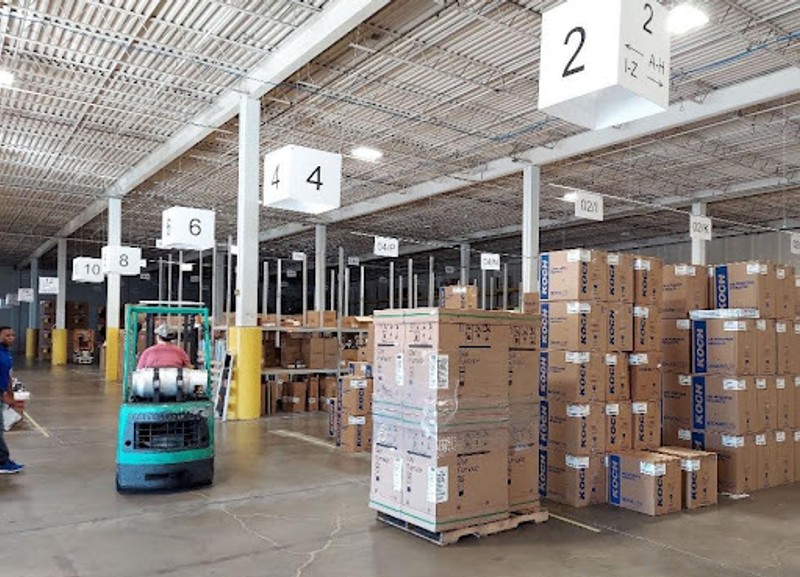
A Good Example of a Visual Warehouse with Clear Aisle Signs
Visual mapping has many forms. It can be a Value Stream Map, a Process Flow Map, or a Spaghetti Diagram. Visual mapping helps people see the process and the non-value-added work. In the Process Flow Map below, the team identified any process step with a red dot as non-value-added and should be eliminated. In the Spaghetti Map, we can see that the warehouse employee is walking around the entire warehouse to pick up the items for an order. The work to pick an order can be significantly reduced if the racking was laid out better and the items placed in the racks based on velocity. This impacts labor productivity and how quickly this company can respond to customer demand. Using a spaghetti map helps employees in the warehouse or factory see how much they are moving, which helps generate ideas for improvements and makes the case for improving the layout. Visual mapping is part of successful change management for a Lean project.
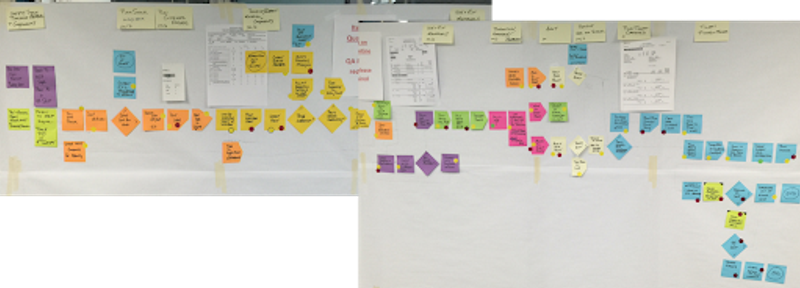
Process Flow Map with Each Step Coded as Green, Yellow or Red
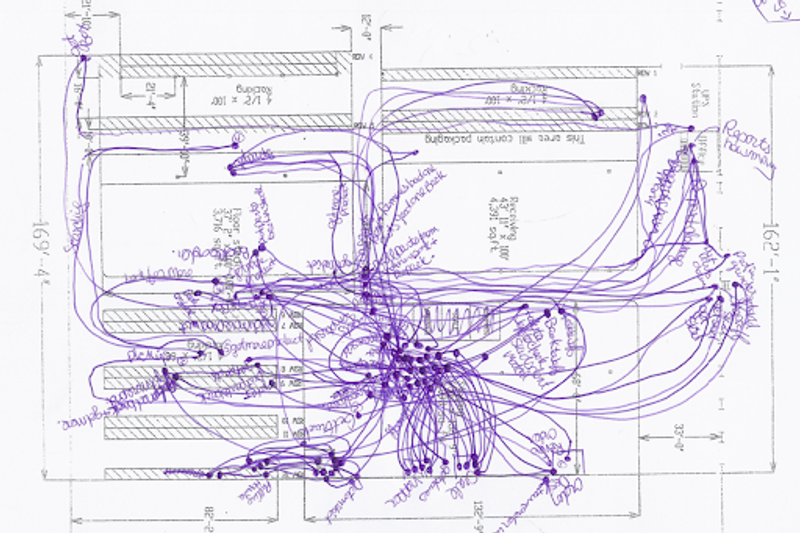
Spaghetti Map of Warehouse Order Picking Shows Excessive Movement
Store
Storage was created to represent warehousing and inventory. However, the concept is much greater and applies to all businesses, including those without inventory. Storage means to prepare. This can be preparation for demand spikes or disruption. It can take the form of optimizing inventory to fulfill customer orders or labor planning. Labor and inventory are two resources that companies need to fulfill customer demand. Inventory storage is straightforward and based on math and warehousing operations. Labor storage is more challenging, however, it can also be ‘stored’.
Every organization has had times when demand surged and sagged. During surges, you need tactics to achieve swift still flow. During sagging demand, you need tactics to hold onto your skilled labor, including hourly warehouse workers, manufacturing operators, and data scientists or consultants. Some tactics for storing labor include:
- Using temporary staffing agencies.
- Having a ‘bench’ of contractors that are skilled and more expensive than employees but have no fixed cost.
- Asking retirees to come back on a part-time basis, as needed.
- Use work-from-home part-timers willing to flex up in hours per week, as needed.
- Having a list of value-added but non-urgent projects to work on during slower demand times.
- Offer salaried workers additional paid time off to compensate for unpaid overtime, but only if they use it during your slow season.
- Finding temporary workers who have other jobs during your slow season but are off during your busy season. My example comes from a moving company that hires teachers to become logisticians for the busy summer moving season. The teachers are smart and capable and are happy to earn a great wage when they are off for summer break.
This is only a small list of possibilities, and many may not apply to your business. However, you need some way to store labor in preparation for surging and sagging demand.
Deliver
Most business people associate delivery with delivering physical goods. It is this, but it is also much more. Delivery is how you get products and services, including customer information.
Physical products are delivered through different transportation modes, such as ships, barges, trucks, and vans. Newer methods include gig-worker delivery using people’s cars, airborne drones, and delivery robots.
Services and information are often delivered by email. This may or may not be the best method of sending information or your service to your customer. If you and your customer are communicating requirements, scope, or updates, that is delivery. Email may be a great tool, or it may be problematic, mistake-prone, and burdensome.
In addition, delivery is often an afterthought unless you are a transportation company. Most businesses forget that delivery is the last thing that happens before your customer sees, touches, and uses your product or service. By thinking of Delivery as a pillar of a Lean System, you will design the delivery to be the best cost and most hassle-free way to get your customer information, products, and services.
Return
Return is often the pillar of Lean System Design that companies want to ignore. This is receiving a returned product or recovering from a service failure. You do not need physical products to design a robust return process. Service businesses also have ‘defects’ in their services that fail to meet customers’ expectations.
A physical return or a service failure creates a Cost of Poor Quality, or COPQ. This cost can take obvious forms or involve hidden processes that happen ‘below the water line’ of management. The best image to represent this is an iceberg. There are obvious costs, such as providing credit or shipping a new product, but the much greater and often unmeasured costs involve all the work dealing with the customer and the failure.
COPQ includes:
- Telling a customer to scrap the failed product and shipping a new one
- Creating a returned material authorization (RMA)
- Cost of shipping the returned product back to your facility
- Receiving, classifying, and storing returned products
- Determining how the failure occurred
- Determining how to reuse the returned product can involve engineering, operations, supply chain, etc.
- Providing credit to the customer
- Redoing the service
- Losing that customer forever
- Communication with the customer
- Low employee morale dealing with an unhappy customer

Many Costs of Poor Quality are ‘Below the Water Line’ and Not Obvious
We include ‘Return’ as a key pillar in Lean System Design because analysis of returns and service failures is the best way to ensure they don’t happen again. When a return or service failure occurs, we immediately (drop everything) have a root cause analysis meeting. This uses the Cause & Effect (or Fishbone) diagram to organize discussions of why the failure happened. This becomes action items that must be follow-up on to ensure we are making changes in the process that eliminate potential to make these mistakes again.
The return or service failure must also be categorized. A key to quality is taxonomy or the science of categorization. Each defect is assigned to a category. As you gather data, the number and impact of the defect categories, put into a Pareto chart will lead you to focus on changes in your process to create continuous improvement in quality.
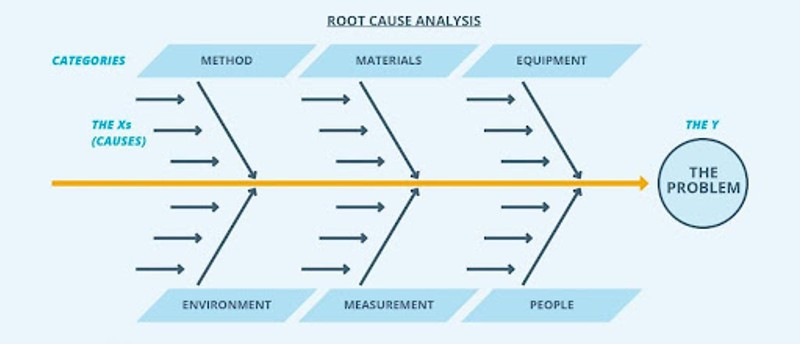
Cause & Effect (Fishbone) Diagram Helps Categorize Potential Root Causes
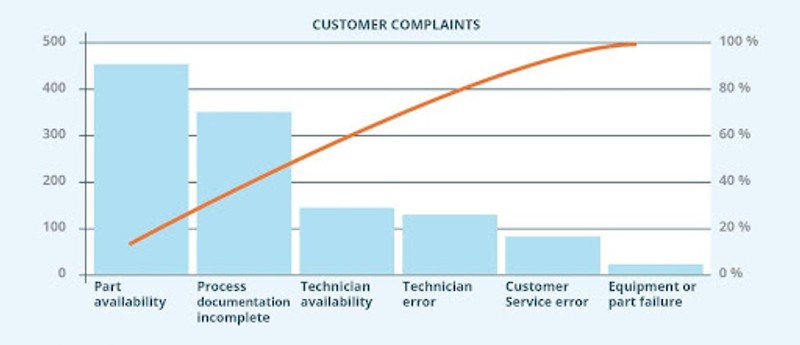
Pareto Charts Help Prioritize the Vital Few from the Useful Many
Who Can Use Lean System Design and Why?
I hope that by now, you can see how every type of organization can and should create Lean System. It doesn’t matter if your business is based on services, finance, healthcare, hospitality, construction, distribution, or manufacturing; if you fulfill customer demand, you want swift and even flow.
More than simply being able to use Lean, the framework of Lean System Design allows for new synergies across the organization. Quality problems hurt future sales but may go unnoticed. A forecast with poor accuracy may lead to the wrong inventory and not having enough space in the warehouse. Creating a culture which enables swift and even flow across your entire business and critical process is not easy.You must adopt Lean, and implement the tools discussed within all 6 pillars. Lean System Design is a ‘system’ approach to improving process and performance which is unparalleled for aligning everyone from operator to CEO to ‘Delivering great things to customers’.
Learn more about Lean Consulting Services.