Download White Paper: Improving Store and DC Productivity through Minimum Order Quantity Analysis
Background
A Value Stream Assessment (See White Paper: Finding Productivity Improvements from Field to Table) at this Grocery Retailer & Distributor identified poor productivity in its distribution centers during order selection and in its retail stores during shelf restocking. A very high percentage of the items selected (picked) in the distribution centers and re-stocked in the stores were in quantities of 1 case.
This company’s roots were as a high volume, limited assortment retailer and distributor. Over time the business had shifted allowing the stores to reorder a higher mix of items at lower volumes. Given the companies market position as a low-price leader, this reduced profit margins.
The two root causes of this shift were identified as:
- Stock-keeping-unit (SKU) count growth outpacing sales growth, and
- Allowing minimum order quantities from the stores to the distribution centers to drop to a quantity of one
This white paper will study how this company quantified the impact of allowing its stores to order in one case quantity and then recalculated minimum order quantities for higher volume items. (For details of how SKUs were reduced see White Paper “SKU Reduction – Biggest SKLUsers”)
A Supply Velocity Consultant led a team of employees through this 5 week project. The Supply Velocity consultant facilitated, but the employees did most of the analysis and therefore owned the improvements.
Project Outline
- Evaluated all SKUs and the case quantity they are most frequently ordered at, to establish baseline data for how stores are ordering
- Time studied retail store shelf restocking and distribution center order selection labor to determine the negative labor productivity impact of the current ordering policy
- Graphed the results in a trend chart
- Determined that the greatest labor productivity improvement happens when the order quantity increases from just 1 to 2 cases
- Recalculated minimum order quantity for all items using Multi-Variable Pareto analysis based on:
- Item unit movement
- Pack-out (number of units that fit on the shelf space allocated in stores)
- Shelf life
- About 20% of all SKUs had a re-calculated minimum order quantity greater than 1 case
- The most conservative methods were used to ensure this project didn’t just push inventory out to stores, resulting in shrink (throwing away items that go beyond their shelf-life limit or are damaged)
- Communicated all items on the minimum order quantity to all stores through a comprehensive communication plan
- Communication plan included data to show stores how increasing minimum order quantity on select items would improve their labor productivity
- Created a control plan to ensure new items, SKU reduction and sales history will be used to update the minimum order quantity on a twice yearly basis
Time Study Analysis
To quantify the problem, we time studied order selection in the distribution centers and shelf restocking in retail stores. We conducted a few snapshot analyses of different distribution centers to understand the current state of “order quantities”. The graph below shows that out of the approximately 2800 items, a majority are ordered in quantities of 1 case. The time study data also showed that the second case selected or stocked is essentially “free” and the same movement is used for two cases as for one case.
At the outset of this project the team was worried that any increase in minimum order quantity would be viewed by store managers as an attempt to push inventory out from the distribution centers to the stores. This data showed that increasing minimum order quantity from one case to just two, gave us the greatest percentage of labor productivity improvement.
However, we didn’t just want to increase all items to a 2 case minimum order quantity. Instead, a statistical tool, Multi-Variable Pareto was used to calculate the proper minimum order quantity based on a mix of inputs.
Distribution Center Order Selection Quantity (# of items picked per quantity)
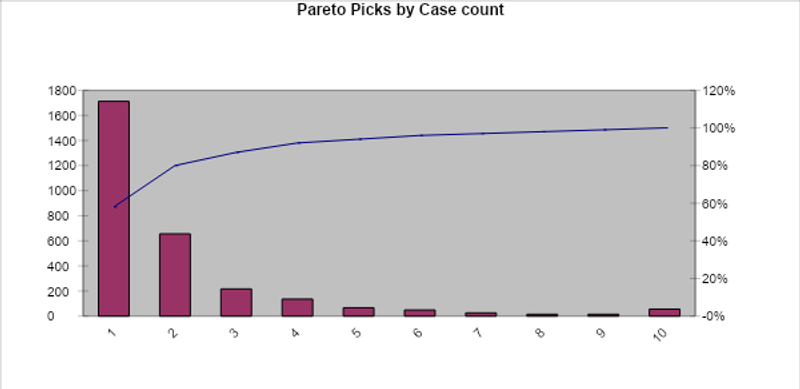
57% of the items in distribution centers were selected at a 1 case quantity

“Time to Select per Case Quantity” in the Distribution Centers – Based on case count per selection
When selecting 2 cases of an item, the time per case drops by 45% from 1 case.

Time to Re-Stock SKUs on Shelves in Stores – Based on case count
When restocking 2 cases of an item, the time per case drops by 61% from 1 case. This shows that the greatest productivity improvement occurs when going from 1 to 2 cases, which is easier to “sell” to the stores than making large increases in minimum order quantity. They can reduce labor by 37 seconds per case by ordering and stocking 2 cases of an item versus 1.
Multi Variable Pareto Analysis
- Recalculated minimum order quantity for all items using Multi-Variable Pareto analysis based on:
- Item unit movement
- Pack-out (number of units that fit on the shelf space allocated in stores)
- Shelf life
- About 20% of all SKUs had a re-calculated minimum order quantity greater than 1 case
- The most conservative methods were used to ensure this project didn’t just push inventory out to stores, resulting in shrink
Multi-Variable Pareto is a method that uses more than one “measure” to sort SKUs from highest to lowest performing. Normal Pareto Analysis has been used to develop guidelines such as the 80/20 rule (20% of customers generate 80% of sales). When using multiple variables, there has to be a way to normalize the data so all variables are part of the analysis.
We used three variables to determine the correct minimum order quantity for an item.
- Cases sold per week on average for each item
- The number of cases that fit in the given shelf space
- Product shelf-life
Each of these variables are positively correlated to Minimum Order Quantity.
- The higher the cases sold equals higher Order Quantity
- The greater the shelf space (pack-out) equals higher Order Quantity
- The longer the item’s shelf-life equals higher Order Quantity
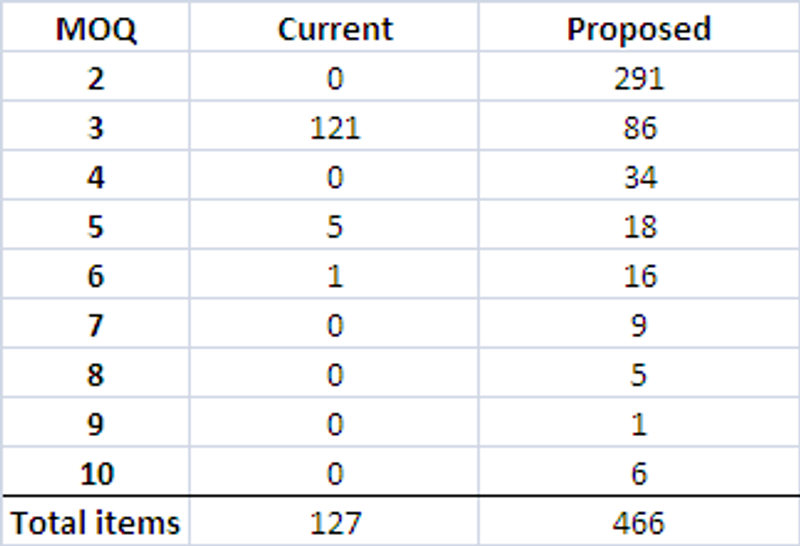
The team of subject matter experts used retail experience to determine each of these factors and their impact on minimum order quantity. Results of this analysis are shown below.
The calculation was very conservative, as the results have shown. Only 466 of 2800 items have a minimum order quantity greater than 1 case. This was largely driven by two factors. Item shelf-life limited our ability to make any shelf-life sensitive item greater than 1 case. Our calculation took this limiting factor into account, to ensure we weren’t causing shrink (throwing away items that go beyond their shelf-life limit or are damaged) at the stores.
In addition, lower case movement drove many items to a 1 case minimum, even if they didn’t have shelf life limitations. The lower case movement is due to SKU proliferation and was addressed by the SKU Reduction (Biggest SKLUsers) project.
Results of Minimum Order Quantity Calculation
Communication & Control Plan
- Communicated with all retail stores about how the minimum order quantity analysis was conducted and the resulting new plan
- Communication plan included data to show stores that increasing minimum order quantity on select items would improve their labor productivity
- Created a control plan so new items, SKU reduction and sales history will update the minimum order quantity on a twice yearly basis
It was critical that this project was presented as a positive for our retail store-customers. We created a communication plan that showed two key aspects of this change:
- The conservative nature of the change
- only 466 of 2800 items are receiving a minimum order quantity increase
- This change is good for the stores and will improve their labor productivity
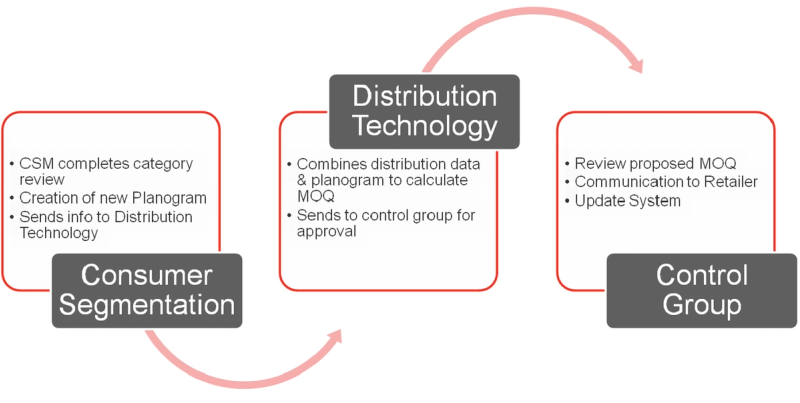
To ensure that this process endures and does not get reversed over time we included a control plan. This is shown in the graphic below. As Category Marketing Managers evaluate items, adding and reducing SKUs, changes will be reflected in new pack-out quantities. This quantity will get fed to Distribution Technology who will recalculate this items’ minimum order quantity using the same Multi-Variable Pareto calculation. A control group, made up of Merchandising, Distribution and Retail Directors will review the list, make changes in the ordering system and communicate changes to store customers.
Results
By taking the higher sales volume SKUs and increasing the store minimum order quantity, we decreased the time per case to stock shelves in the stores and select items in the distribution centers.
Using only the 1 to 2 case increase in minimum order quantity for the 466 SKUs reduced the labor time per case resulting in a labor savings of $1.2 million.
The expectation for this process is to slowly grow the number items with a minimum order quantity greater than 1 case beyond 20%. By rationalizing and reducing SKUs we should increase the shelf pack-out of remaining items, thereby increasing the minimum order quantity.
Learn more about our Lean Warehouse – Warehouse Optimization services.